

Filtration is present in our daily lives. It plays a role in protecting engines, industrial processes, air purification, water treatment, food production, and more. Its main function is to retain unwanted contaminants to protect equipment, ensure the quality of final products, and guarantee the safety of people.
The nature of these contaminants varies greatly depending on the application: in hydraulics , they often include water, metallic particles, or residues related to fluid degradation and wear on moving parts of the circuit; in compressed air , they are more commonly oil mists, dust, and moisture; in water treatment , they involve suspended solids or chemical substances. These are just a few examples: each process can generate specific contaminants or be exposed to them.
These differences necessitate choosing a filter medium adapted to both the fluid being treated and the type of contaminants present, as well as the operating conditions.
Filtration and filter media: definitions and principles
Filtration is a process used to separate two or more elements from a heterogeneous mixture.
Several filtration methods exist: mechanical (passage through a porous material), physical (centrifugation, decantation), and chemical (adsorption, ion exchange). Each method addresses specific needs depending on the nature of the fluid, the characteristics of the contaminants, and the process requirements.
Among these, mechanical filtration plays a fundamental role in many sectors. It involves passing the fluid through a filter medium whose structure is designed to trap contaminants based on their size or physical properties. Depending on the medium’s design, impurities can be retained:
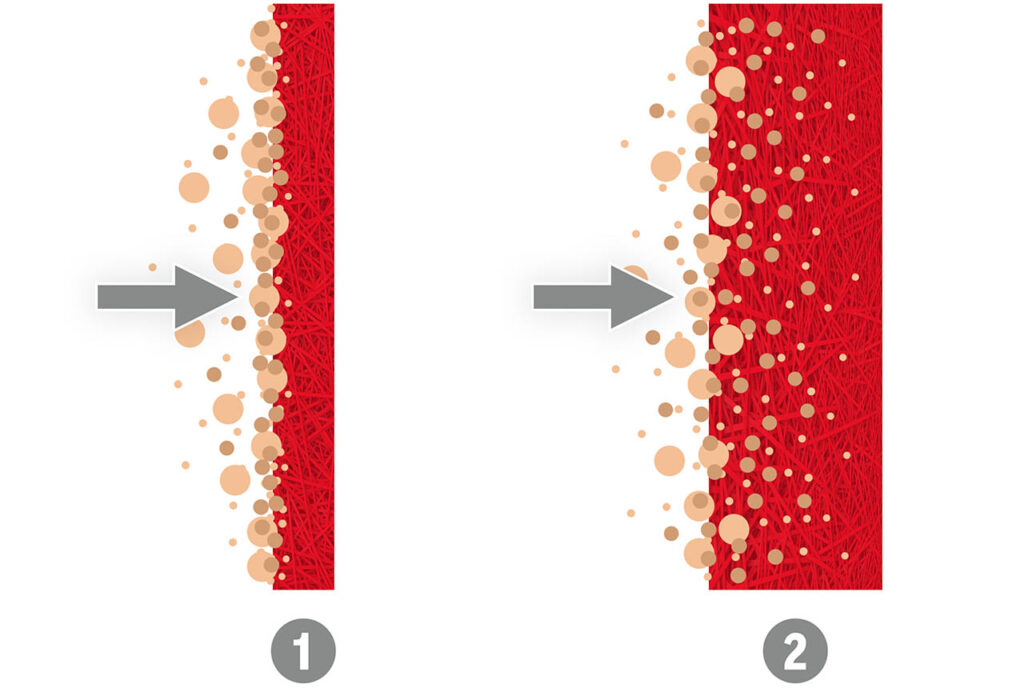
- 1. Surface: The particles are retained on the surface of the medium, which acts as a sieve with calibrated pores. The larger the surface area, the greater the initial retention capacity. This process is suitable for fluids with low loading or containing particles of uniform size.
- 2. Depth filtration: The fluid passes through a three-dimensional medium, where particles are progressively trapped at different levels within the material’s thickness, depending on their size. This method is especially effective for highly concentrated fluids or those containing contaminants of varying sizes. In some cases, the material is designed with graded porosity, meaning larger pores at the surface to trap larger particles, and progressively finer pores towards the interior to retain smaller ones . This ” progressive filter ” arrangement distributes the contaminant load throughout the medium ‘s thickness , improving retention capacity and delaying clogging .
Whether for surface or deep filtration, the performance of a filter medium depends primarily on its characteristics, which determine its compatibility with the intended application. Examining these characteristics is essential for selecting the most suitable solution.
Criteria for choosing a filter medium
Several parameters directly influence the performance and lifespan of the filter media.
International standards and requirements sometimes mandate the use of certified equipment depending on the sector. These standards guarantee the safety, quality, and conformity of processes, and increasingly incorporate sustainable development criteria.
The material and its physical and chemical properties.
The structure , which determines how the particles are retained.
Surface treatments , which modify the interaction of the medium with certain elements.
Chemical, thermal and mechanical compatibility , essential to withstand the stresses of the process.
The filtration threshold , which corresponds to the minimum size of contaminant that a filter medium can retain, is usually expressed in micrometers (µm).
The amount of contaminants that must be retained.